What motivated you to pursue a master’s degree, and more specifically, why a master’s at Piet Zwart Institute?
I moved to Rotterdam in 2021 to pursue an internship with Shimmer for their publishing project, right after completing my Bachelor’s degree in Digital Art (Fine Arts) in Malta. While developing my practice and building professional relationships with both MaMA and Shimmer, I realised it was the right moment to further my education and create a stronger structure for my artistic research and practice.
I specifically chose the PZI because I was already familiar with Rotterdam and its cultural circle, but I also wanted to expand my network by entering Experimental Publishing. XPUB was a department I had known about for years through the work of its alumni and their public events. What also interested me in XPUB was its openness to enroll people from different disciplines, and the way ideas around publishing are explored through a wide range of mediums, from coding and sound performance to technical experimentation and tinkering.
You are now close to graduating; what is the focus of your research project, and what challenges or obstacles do you encounter in the process? And what aspects of your project are you most exited about?
My research project is called 'A Familiar Materiality', a project that explores the merging of the material worlds of traditional craft and communication technology, specifically DIY radio wave receivers. Throughout the project, I have applied familiar handicraft techniques to the making of radio receivers, investigating how the function and perception of these objects alter through the materials used in their construction. The project takes on an introspective approach; growing up alongside my family’s contrasting hobbies of textile work and radio-making, I developed a familiarity with both practices.
The most challenging aspect has certainly been the technical prototyping of the physical work. The aim will be for the radio wave receivers to merge with different craft techniques, with each object intertwining its own narrative through the materials and methods it draws upon. Over the past few months, I have been testing how these materials (copper wire, thread, wood, and metal) interact and merge with one another in the process of creating an analogue radio wave receiver.
I’m also very excited to present my thesis alongside the project itself. I feel the audience will gain a deeper understanding of the work once they are able to situate it within my family’s narrative, which is interwoven in the tangible aspects of the project.
How has your studies at PZI contributed to your growth as an artist/designer? Are there any mentors, experiences or insights that significantly have influenced your work?
Before starting XPUB, my practice was quite autonomous. I occasionally hosted workshops as a way of conducting research, but I didn't always have the opportunity to collaborate closely with other artists and designers. That changed during the first year of the Master’s programme, where we were consistently encouraged to work together throughout our three Special Issue events. It became a valuable way to get to know everyone in the class and to experience this merging of ideas and exchange of knowledge, and approaches
One experience that particularly inspired the direction of my Graduation project was our visit to — and later exhibition at — the Telecom Museum. I was fascinated by the huge collection of communication technology artefacts preserved across its many rooms, and how the building’s own history remained so present through its transformation into a museum dedicated to communication technologies.
How do you see yourself in the world after graduating, and what are you most looking forward to after graduating?
I currently have a few exhibitions and projects coming up in both the Netherlands and Malta after graduating, so things already feel quite busy. At the same time, I’m really excited to dive deeper into this world and finally have the space and time to fully focus on my own projects, while also tapping back into the ideas that have inspired me over the past two years.
Do you have any advice for current of prospective students in your programme?
I really encourage collaboration. Your classmates may become future collaborators, you might even end up sharing a studio space or forming a collective together. Studio work time is important, but I’ll really miss conversations and spontaneous discussions on the couch, by the printer, or around the coffee machine. That kind of informal feedback and brainstorming is something I will cherish.
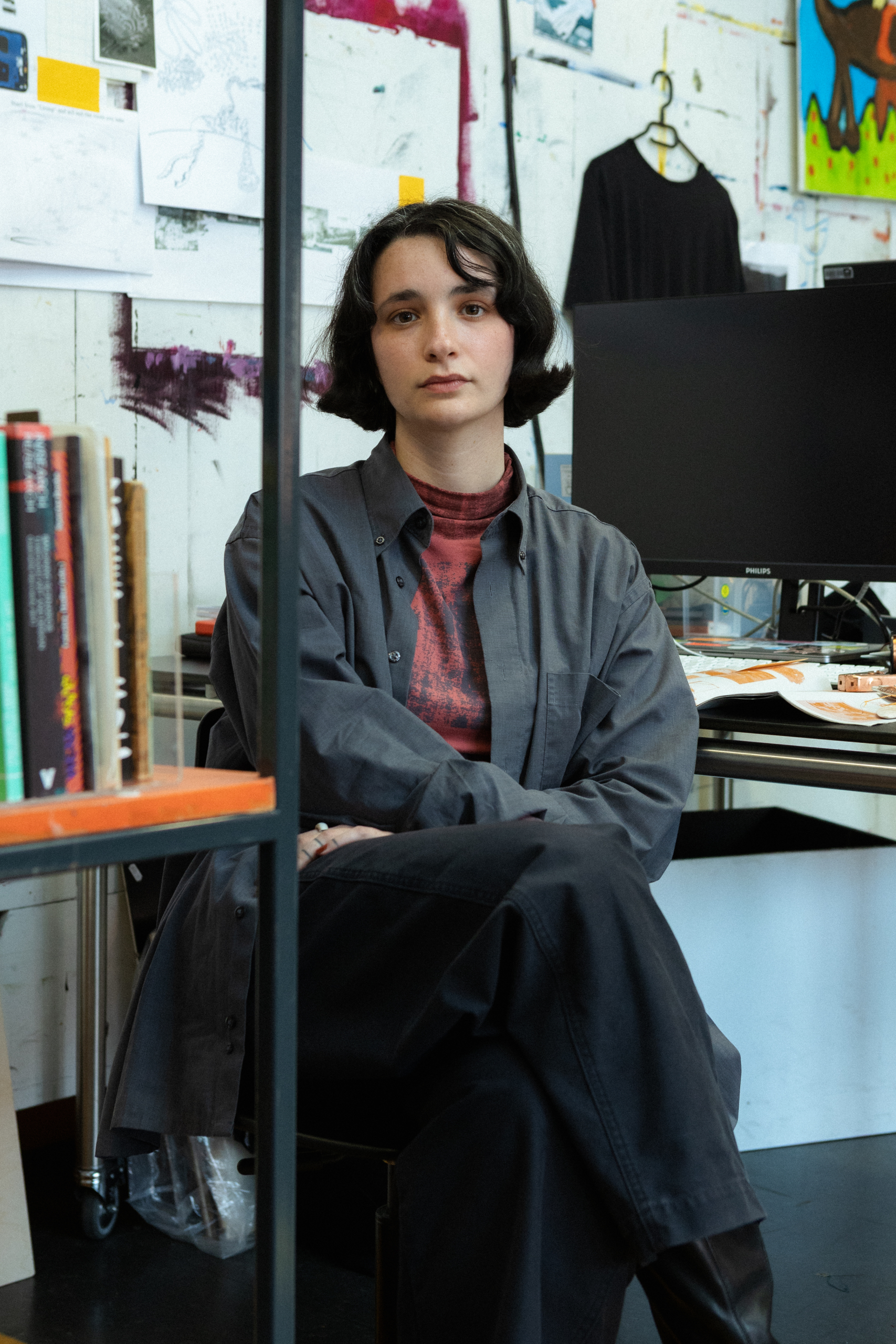 photo Jake Caleb