What motivated you to pursue a master’s degree, and more specifically, why a master’s at Piet Zwart Institute?
After my bachelor’s degree in industrial design engineering, I was looking for a master’s in design that would help me grow as a designer. I had the technical basis, but what I was missing was the ability to tell stories through my designs. To place myself and my work in a larger system and see how it connects, foster that network and add to it. I chose the master Design at PZI specifically because it’s so open. You enter with your own design question and spend two years researching in that field. When I started the master Design I thought that I was going to end up with a textile and fashion collection, but my research led me elsewhere and now I’m archiving invisible domestic labour through ceramics. It might sound like a completely different project, but while the medium has changed, it serves my research very well and has also allowed me to grow as a designer and researcher. The master provides a very encouraging environment to experiment and to broaden or deepen your artistic practice.
You are now close to graduating; what is the focus of your research project, and what challenges or obstacles do you encounter in the process? And what aspects of your project are you most excited about?
Yes, I’m very excited about my research project! The last 1,5 years I have researched invisible labour in the domestic environment and the position of women, specifically looking at textile work and maintenance from the Middle Ages up until now. I am currently writing my publication in which I discuss female invisibility through craft. I discuss the role of capitalism and religion in the creation and continuation of gender roles in society, the devaluation of textile art as ‘craft’ and how that has been historically used as a cover for resistance. My research also discusses the role of ‘making’ in this context, where I also relate it to my personal experiences as a designer and maker myself. The physical manifestation of this research will be a ceramic fireplace. I will use a reinterpretation of an ancient ceramics firing technique to fire folded textile into the porcelain tiles, in a similar manner in which you would fold your laundry. The abstract traces of this folded cloth will become extra visible when I shine a light through the translucent porcelain tiles. Highlighting domestic labour like doing the laundry, which usually only becomes visible once it fails, for example when the laundry is not clean. I’m very excited about both the publication as well as the ceramics installation. I like how they can exist together as well as independently for different audiences. The actual making of all the porcelain tiles and firing them with this specific technique will be quite a challenge, so I’m excited to tackle that!
How has your studies at PZI contributed to your growth as an artist/designer? Are there any mentors, experiences or insights that significantly have influenced your work?
The encouraging environment played a big role in my material experiments and deepening my artistic practice. The tutors are all very engaged and curious, which is really nice. It’s a very safe environment to try new things and get feedback from tutors as well as peers.
How do you see yourself in the world after graduating, and what are you most looking forward to after graduating?
I will keep expanding my artistic practice and ideally take on my three favourite roles: researcher, designer and maker.
Do you have any advice for current of prospective students in your programme
I would advise doing loads of experiments. Try out different things, with different materials, with different people. Use the facilities offered by the academy and have fun.
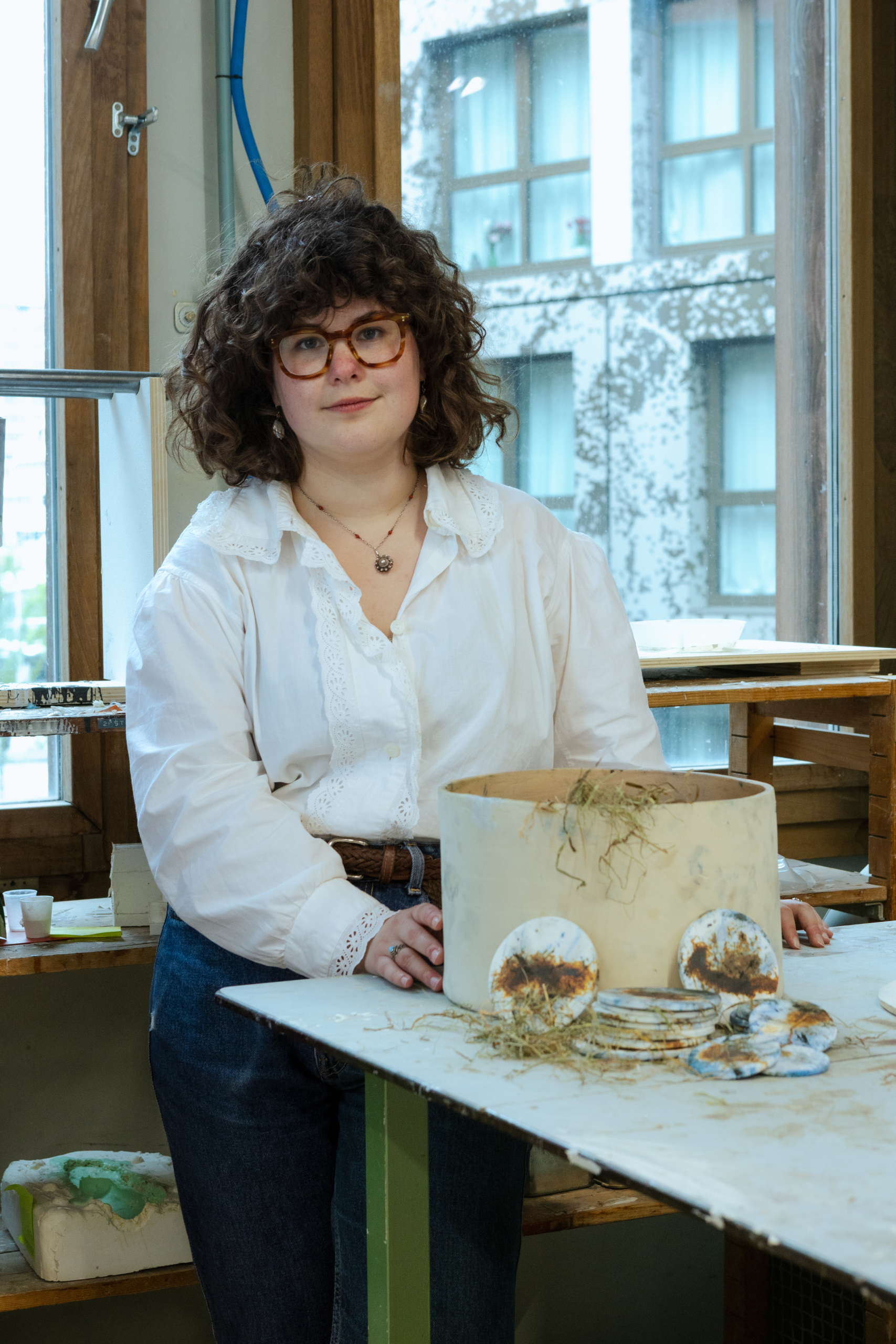 photo Jake Caleb