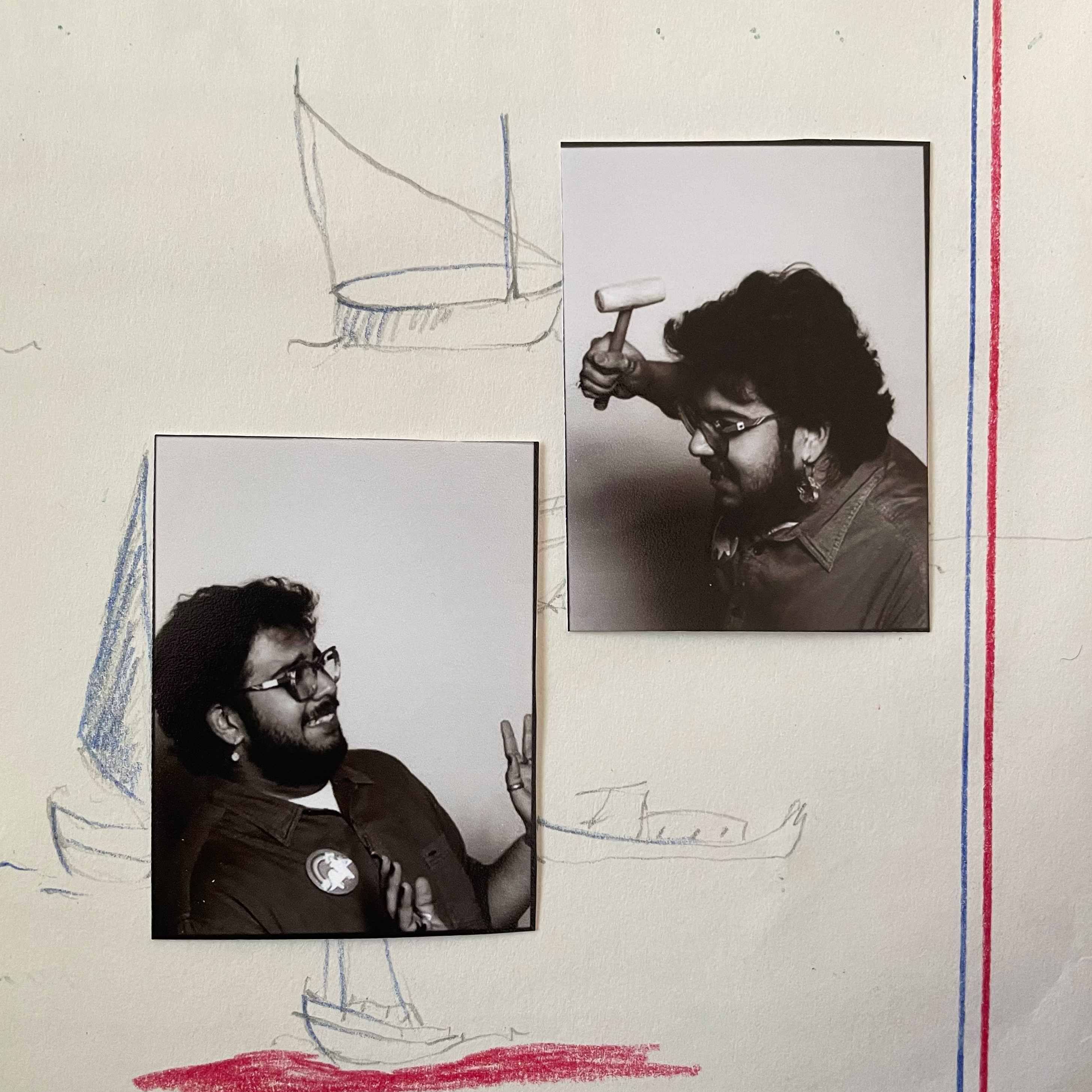
Maoro Bultheel (24) moves between cities, disciplines and materials with a restless curiosity. Originally from Brussels and now based between Antwerp and Rotterdam, his path to the Willem de Kooning Academy did begin with a love for jewellery making. Trained as a goldsmith and working as a piercer, making has always been central to his life. What brought him to Rotterdam was not a desire to specialisefurther, but the opposite. “I believe the more skills you have, the more possibilities you create for yourself,” he explains. “Here, the curriculum is much freer. You can really shape your own path.” That opennesshas allowed his graduation project to evolve into something both conceptual and highly technical. It is a project that questions the systems we live in, while physically embodying those ideas through sound, form and material.
Culture, Convenience, and the Loss of Meaning
At the core of Maoro’s graduation work lies a critical reflection on contemporary consumer culture. His research focuses on what he describes as a growing “convenience culture”, and the ways in which itreshapes not only products, but human behaviour and identity. “My statement is quite simple,” he says. “Convenience is destroying culture.”
This perspective is rooted in personal experience. Having travelled extensively, including time spent in Japan, the United States and North Africa, he began noticing patterns in how cultures shift under thepressure of globalisation and mass production. “We often think of places like Japan as having a strong, ancient culture,” he reflects. “But in reality, so much of it has become hyper-commercial andstandardised. A lot of that identity has faded in the last decades.”
For Maoro, the visual language of products plays a crucial role in this shift. He points to globally recognisable objects as examples of cultural flattening. “Take something like an iPhone,” he says. “It’s a metal and glass surface, very clean, very efficient, but it doesn’t say anything about where it comes from. It’s designed for everyone, which also means it belongs to no one.”
This idea of homogenisation extends beyond objects into human interaction. From dating apps to luxury fashion, he sees a growing tendency to commodify experience and identity. “If everything becomeseasy and accessible, we lose a sense of value,” he explains. “Things only really mean something when effort is involved.”
Translating Theory into Sound and Form
Maoro translates these ideas into a physical and sensory experience. His graduation project combines a custom-built synthesiser with a self-constructed acoustic speaker, forming a complete system in whichconcept and object are inseparable.
The synthesiser, developed earlier in the year, already reflects the aesthetics he is investigating. “It has this very sleek, futuristic look,” he says. “Geometric, minimal, almost anonymous.” The object deliberately mirrors the kind of homogenised design language he critiques.
Building on that, he is now constructing a speaker that operates differently from conventional models. Instead of relying on standard drivers, the structure itself becomes the instrument. “It’s essentially a resonating body, like a violin or a piano,” he explains. “The sound travels through the material and makes the whole object vibrate.”
The process is as intricate as it is experimental. Working primarily with wood, Maoro is shaping the speaker through techniques more commonly associated with instrument making. “I built a steam chamber tobend the wooden strips,” he says. “Then I assemble them over moulds, piece by piece. It’s very precise work. Everything has to fit perfectly, otherwise it won’t function.”
The result, if successful, will be a speaker that produces a more organic, almost analogue sound from digital input. A deliberate tension emerges between the synthetic and the natural, between control andresonance. “It’s about simulating something human within something very constructed,” he notes.
Repetition, Emptiness, and Emotional Response
Sound itself plays a crucial role in how the work communicates. Alongside the objects, Maoro is composing a piece of music that reflects the same themes of repetition and uniformity. Drawing inspirationfrom films such as Koyaanisqatsi, he is interested in how rhythm and structure can evoke emotional responses tied to modern life. “That film shows the constant movement of production, of systems that justkeep going,” he says. “The music is very repetitive, almost hypnotic. It creates this feeling of emptiness, or even sadness.” His own composition follows a similar logic. Played through the speaker on a continuous loop, the sound becomes part of the installation’s atmosphere. Visitors are first drawn in by the object itself, then gradually confronted with the emotional weight of the work. “I want people to feel something before they understand it,” he explains. “And then, after reading into it, to have that moment where it clicks.”
Making as a Driving Force
Despite the conceptual depth of his project, Maoro consistently returns to the act of making as his primary motivation. His days are long and immersive, often spent entirely in the workshop. “I’m here frommorning to evening most days,” he says. “I just really enjoy the process. The more complex it gets, the more interesting it becomes.” That drive also comes with challenges. The technical demands of thespeaker leave little room for error. “Everything has to connect perfectly,” he admits. “If there are gaps or mistakes, I might have to rebuild parts of it. And there’s no real blueprint for what I’m doing.” At the sametime, the uncertainty is part of what makes the project meaningful. It reflects the very idea he is exploring, that value is tied to effort, risk and time. “If everything works immediately, it doesn’t feel the same,” he says.
Between Graduating and What Comes Next
As graduation approaches, Maoro finds himself in a familiar in-between space. “It feels a bit like limbo,” he reflects. “You’re no longer a beginner, but not fully out in the world either.” While part of him wouldhave liked more time to explore different techniques, another part is ready to move forward.
His future plans remain open, but the direction is clear. He envisions building a practice that allows him to continue experimenting across disciplines, possibly through his own studio. “Designing, failing, tryingagain, that whole process is what excites me,” he says.
At the same time, he recognises the pull of his previous experience in jewellery, a field where he already has a network and resources. “That would be a safer path,” he admits. “But I’m also interested in pushing further into what I’m doing now.”
Maoro’s graduation project is not just about objects or sound, but about questioning the systems that shape both. It asks what is lost when everything becomes efficient, accessible and uniform, and what itmight mean to reintroduce friction, effort and individuality into the things we make. And perhaps that is where his work finds its strongest position. In a world increasingly defined by speed and convenience, choosing to make something slowly, carefully and with intention becomes a statement in itself.