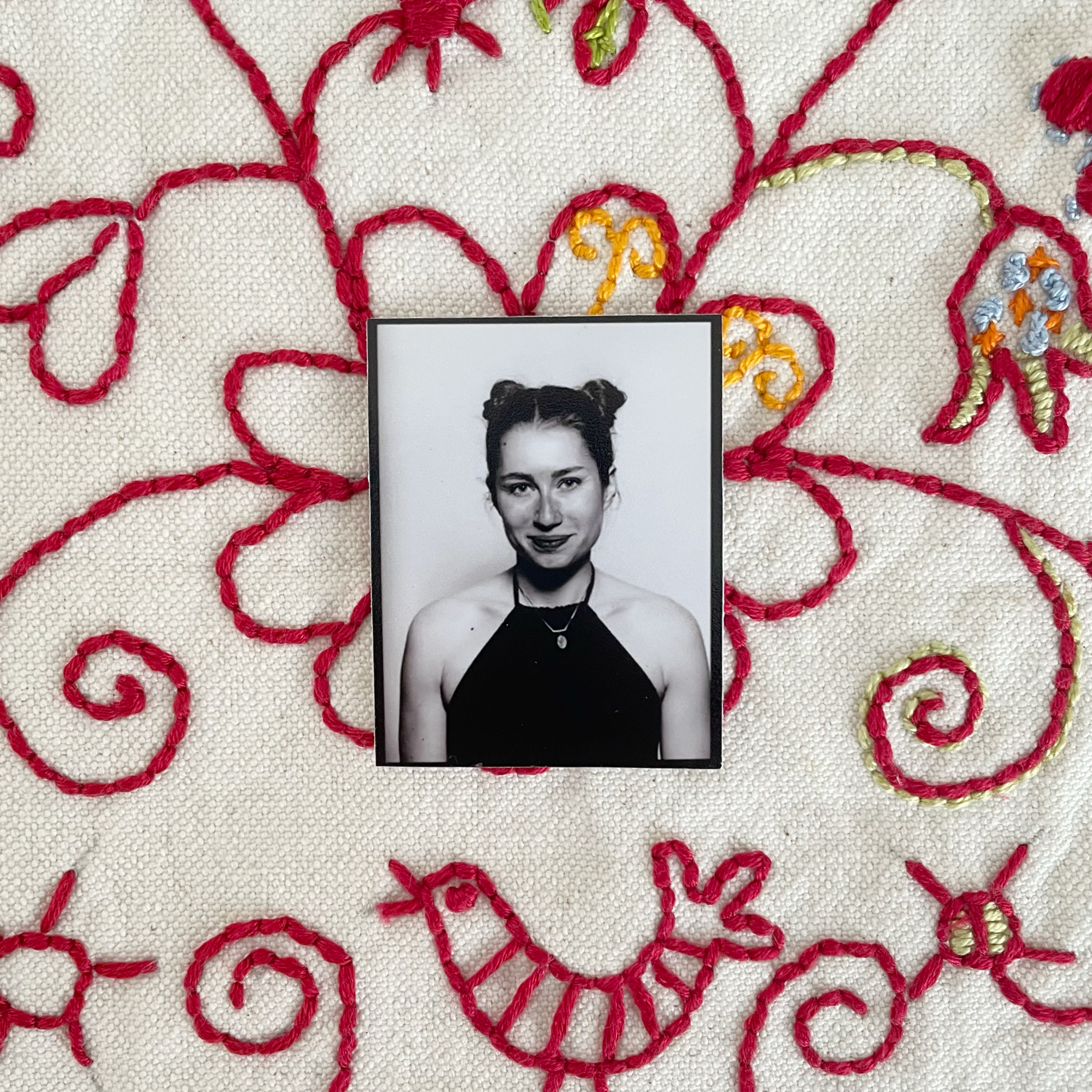
When May Kedem (31) first arrived in the Netherlands nine years ago, she did not come with a clear plan to study design. Originally from Israel, she had been travelling when she unexpectedly ran out of money in Amsterdam. Thanks to her Dutch passport through her father, she stayed, found work, and gradually built a life in the Netherlands. But there was always another ambition in the background. "I always dreamed of studying design and architecture," she says. "When I chose WdKA, I wanted a place where I could really enjoy learning. The facilities felt like a playground. There was so much freedom to explore."
Now, at 31 years old and nearing graduation from Spatial Design, May finds herself working at the intersection of material innovation, sustainability, architecture, and wellbeing. Her graduation project, Patina of Performance, explores how natural materials can shape not only our buildings, but also our experience of being in them.
From Elephant Grass to Architectural Tiles
At the heart of the project is a material experiment that began through Rotterdam's circular economy network at BlueCity. Working with elephant grass, lime, seaweed, and natural binders, May developed a series of acoustic wall tiles designed as a sustainable alternative to conventional building materials. "My ambition is ultimately much bigger than tiles," she explains. "I would love for this kind of material to become a replacement for concrete one day."
For now, however, the project focuses on interiors. The tiles she is developing help regulate humidity, absorb sound, and create healthier indoor environments. Inspired partly by the Japanese plastering technique Shikkui, the material remains breathable and active within a space rather than functioning as a passive surface. "I've always believed that our environment shapes us," she says. "The materials around us matter. Being surrounded by natural materials creates a very different experience than being surrounded by synthetic coatings, chemicals, and artificial surfaces." That relationship between material and emotion has become the central question of her work."How can I design environments that contribute to wellbeing?" sheasks. "That's really what this project is about."
Falling in Love With Materials
May describes herself as someone who is deeply drawn to tactile experiences. "I can fall in love with a stone," she laughs. "I love things I can touch, hold, and feel." That fascination led her naturally toward material experimentation. While studying Spatial Design, she often found herself moving between architectural thinking and product design. Developing a materialsystem allowed those interests to merge. "Spatial Design sometimes felt like I was somewhere in between designing spaces and designing objects," she says. "This project feels like the perfect combination." After months of experimentation, she has now finalized the material recipe and shifted her focus toward aesthetics: exploring different patterns, colours, coatings, and tile forms."I have something that works," she says. "Now I'm investigating how it wants to look."
Letting the Material Lead
One of the biggest surprises during the process was discovering how much the material itself influenced the outcome. "What I didn't expect is that the tiles almost designed themselves," May says. Because she works with natural ingredients, every prototype reacts slightly differently. Cracks, colour variations, textures, and imperfections emerged throughout the process. Instead of correcting them, she began embracing them. "My mistakes became the most beautiful tiles," she says. "The defects turned out to be the most interesting part." This realization eventually became central to the project. Rather than creating static building products, May became fascinated by materials that continue to change over time. "I'm interested in howageing and time become design agents," she explains. "The material breathes. It changes. It participates in the space."
The project's title, Patina of Performance, reflects that idea. A patina is usually seen as a sign of ageing, but for May it represents a material's ability to evolve and tell its own story. "There's beauty in imperfection," she says. "The material taught me that."
Learning Through Making
The project also marks a significant shift in how May approaches design research. Earlier in her studies, she would begin by reading extensively before making anything. While that approach generated many ideas, it often left her overwhelmed. "I always saw potential in everything," she says. "Then I would get lost." This time, she started differently. "I just went for it."Beforediving into theory, she began experimenting with materials, testing recipes, and making prototypes. Only later did she start researching existing techniques and comparing her discoveries with other designers and material innovators."It's the first project where I've really worked this way," she says. "I learned a lot about myself during my studies. I know my values better now, so it's easier to trust the process." That process has become surprisingly ritualistic. Every Sunday she spends hours producing new tiles. Throughout the week she continues caring for them, remoulding, coating, moistening, and refining them as they cure. "I take care of them every morning," she says. "They're almost like living things." Alongside the material research, she is also creating a publication documenting her findings, recipes, experiments, and design journey. "I want to make a beautiful book that captures the whole process."
A Shift in Perspective
Looking back on her time at the academy, May sees a clear evolution in her work. "When I started, I was focused on large architectural gestures," she says. "I wanted to design big spaces and play with form, light, and shadow." Over time, her attention shifted toward the smallest details. "Now I'm interested in materials themselves. The tiny details are what create the biggerpicture." The academy's workshops, machines, and making facilities played an important role in that transformation."The opportunity to experiment with different materials and techniques influenced me enormously," she says. "It taught me how to research through making."
Beyond Functionality
While the project has attracted interest from tutors, station coordinators, and partners at BlueCity, May is careful not to focus solely on future applications. Of course, she sees potential. The tiles could function as decorative interior elements today and perhaps evolve into larger construction systems in the future. But right now, she is more interested in what the materialcan communicate. "I want to show that functionality and emotional experience don't have to be separate things," she says. Too often, she believes, sustainable architecture is discussed only in terms of performance, efficiency, or technical solutions. Her project argues for a more holistic approach. "A space doesn't have to be either practical or beautiful," she says. "It canbe both." Just as importantly, it can be environmentally responsible while also creating meaningful sensory experiences. "I think we can coexist with our environment in a different way."
Looking Forward
As graduation approaches, May finds herself experiencing multiple emotions at once. "It's everything together," she says. "Excitement, happiness, sadness. I can't quite believe it's almost over." The pressure she felt at the start of the project has slowly faded. "I realized that expectations don't help me," she says. "The best work happens when I enjoy the process and focus on what I love."
After graduation, she hopes to continue exploring the relationship between materials, architecture, and human wellbeing. Whether through design, architecture, or further study, she wants her work to contribute positively to communities and environments. For now, though, her focus remains on the tiles quietly drying in her studio. Success, she says, will not necessarilybe measured by technical performance or commercial interest. Instead, it will happen when someone encounters the work and feels something. "I want people to touch it," she says. "To experience it physically. If someone enters the space, feels connected to the present moment, and feels calm, then I think I've succeeded."