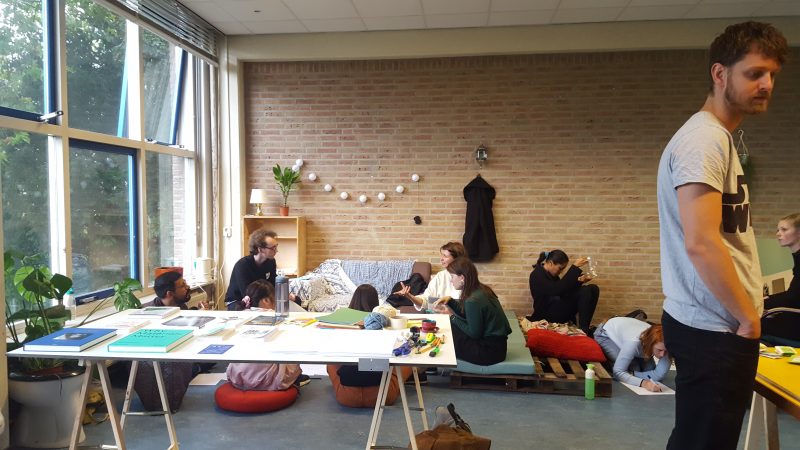
 Brainstorming session during the Worldmaking workshop delivered by lecturer Tamara de Groot at Het Wijkpaleis. Photograph: Josue Amador
In 2019, the first edition of the experimental and innovative RASL minor “Re-Imagining Tomorrow through Arts & Sciences” took place, bringing together students and educators from Willem de Kooning Academy, Codarts University of the Arts and Erasmus University to engage in transdisciplinary collaboration and re-approach complex societal issues. The experiences and insights following this first successful edition led to the development of a pedagogical vision predicated on the idea of provisional pedagogies in zones of tension. The text is the result of an ongoing collaboration between many committed educators from the participating institutions, without whom the minor nor this pedagogical vision could exist.
The minor Re-Imagining Tomorrow through Arts & Sciences is made possible by a Comenius Leadership Grant.
_______________________________________________
Transdisciplinary Education Across and Beyond Arts & Sciences
Transdisciplinarity is a contested, fuzzy concept. While its boundaries are imprecise, we can nevertheless, distil two dominant conceptions of what it means to be or become transdisciplinary. The first conception of transdisciplinarity emphasizes the improvement of scientific practices by bringing together scientists and external stakeholders (from government, industry, society) to articulate and solve complex research problems. This particular conception emphasizes mode-2 knowledge production, the application of knowledge through transdisciplinary collaboration in context-specific situations (Gibbons et al., 1994), and is particularly prominent in environmental and sustainability studies. The second conception of transdisciplinarity is more explicitly focused on creating new ways of thinking and doing through paradigmatic shifts, which challenge and change existing structures lying at the root of complex societal issues. This second meaning emphasizes the suitability of transdisciplinary collaborations across different knowledge domains to enable these paradigmatic shifts.
The difference between the two approaches is crucial: while the first treats transdisciplinarity as an additive model, emphasizing the problem-solving potential of transdisciplinary practices, the second approaches transdisciplinarity as a mode to rearticulate complex societal problems. In this capacity, the second conception of transdisciplinary research is akin to pragmatist social philosophies that take seriously the (artistic, disciplinary, technological) means by which ‘societal problems’ come to be articulated, and the various publics involved in their articulation or formation (see e.g., Marres, 2012). Manfred Max-Neef (2005), then, categorises these two types of transdisciplinarity as weak and strong, with weak transdisciplinarity referring to the practical, systematic approach of tackling problems and strong transdisciplinarity as a way to see the world in its complexity and interrelatedness. While weak transdisciplinarity can be part of a strong transdisciplinary approach, in and of itself it does not achieve paradigmatic shifts, as it requires a highly reflexive attitude to do so.
It is only through extensive critical reflection on existing power relations that learning can take place which enables ‘an onto-epistemological shift among a group of collaborative researchers’ (Ross & Mitchell, 2018). This means addressing not only dynamics of inequality between disciplines and epistemologies, but also the Humanist, Eurocentric and anthropocentric foundations on which Western education is built, to arrive at ‘non-dominant relations across difference’ (De Lissovoy, 2010). In their proposal for Transforming Transdisciplinarity, Mitchell and Ross (2018) emphasize this way of learning as a way to allow for a deeper level of collaboration that encourages strong transdisciplinarity.
In the minor Re-Imagining Tomorrow through Arts & Sciences, we create a setting in which students can approach this higher order of collaborative practice and facilitate this through extensive critical reflection on the ways we think, make and learn, to encourage strong transdisciplinarity and stretch ways of knowing and being in the world. In close collaboration with the tutor team, students explore what it means to work and learn together with teachers, their fellow students and guest experts. They find themselves in the complicated space in-between several institutions and engage in self-directed research in which they can question the very structures that shape their education and worlds.
Provisional Pedagogies in Zones of Tension
To enable this, we make explicit and work with the frictions, conflicts and paradoxes inherent to transdisciplinary practice across and beyond the arts and sciences. These tensions emerge as a result of the coming together of people with different disciplinary backgrounds, world views, ways of knowing, dispositions and practices. By doing so we aim not to gloss over such differences and tensions, but to make them productive. While there are differences between participating members in any collaborative setting, in transdisciplinary collaborations the acknowledgement of, and working with difference is essential because it makes visible disciplinary logics and paradigms. Difference in transdisciplinary collaboration manifests itself in zones of tension, where discipline-informed ways of doing clash with each other and with certain core aspects of transdisciplinary practice.
From previous experiences with transdisciplinary education across and beyond arts and sciences, as well as from literature on the topic, four zones of tension have been identified that lie at the core of this type of transdisciplinary education:
*Collaboration across and beyond disciplines: Collaboration between and beyond disciplines has a tendency to take shape in an additive form, in which different approaches or practices are simply ‘added’ to each other to produce a putative ‘view from nowhere’ (Haraway, 1988). Such an additive approach, however, has significant drawbacks, in that it does not necessarily require reflexivity and third-order reflection on the character of disciplinary knowledges and practices themselves. Throughout this programme, then, teachers and students will be challenged to not only ‘bring in’ knowledges and practices, but to critically reflect on the knowledges and practices they are already working in (and which they might not be very aware of). This dimension also has a social component. While social dynamics in transdisciplinary teams may come to rely on an idea of individual participants as representatives of ‘their’ practice, the task of this programme is also to allow people to reconsider their own practice critically.
*Equality of knowledge: Collaboration must take place based on an assumption of the equality of knowledge. At the same time, this emphasis on non-hierarchical relations between disciplines and practices runs the risk of sliding once again into the additive model of transdisciplinarity, in which knowledges can simply be stacked up without necessarily producing a transformation in the way concerns are apprehended or articulated. Equality of knowledge, then, also requires of students an attitude of attention and curiosity with regards to other ways of knowing and acting.
*Engagement: There is a productive tension, in transdisciplinary research and practice, between ‘engagement’ as a matter of political choice and volition – one chooses to be or become engaged with political issue X or Y – and engagement as a condition of social life, in which we are always already ‘engaged’ with each other and with the world through networks of various sorts (technological, aesthetic, economic, etc.). Transdisciplinary practice has to be aware of these modes of engagement and bring them into productive relation with each other.
*Making public(s): Making public the outcomes of research or artistic processes presupposes a receiving public or several publics. Publics, however, do not exist prior to being addressed – they exist in their relationship with whatever they are meant to receive. Transdisciplinary knowledge and practices, in their creation of new ways of knowing the world, both respond to and produce new publics. In the minor, students become aware of the worldmaking capacity of knowledge production, and how (the making public of) their work and the way in which they present it is not only influenced by their audience but also creates new publics.
Through critical reflection on, and a commitment to work from these zones of tension, students participating in the minor not only become aware of the taken-for-granted schematics and habits of thinking, doing, and making (cf. Stengers, 2005) underlying structures that shape how they learn and know the world, but also explore what working in these zones of tension can do, and how this can lead to new collaborative practices. In this sense, the programme does not treat transdisciplinarity as a single method or means towards an end – solving a problem - but rather as itself the object of and for collaborative, open-ended practice. Precisely what transdisciplinarity would mean and look like in practice is the very question students will work with and through during their engagement in this minor.
In the minor, teaching staff and students depart on a journey together to experiment with different ways of collective learning. Pedagogy becomes not an instrument to impart knowledge or standardized procedure that predetermines how teaching and learning take place, but rather a leading question and matter of concern (Latour, 2004). In questioning and changing how we learn throughout a learning trajectory, pedagogy becomes multiple, situated and temporary – pedagogy turns into pedagogies, and these pedagogies are necessarily provisional. Provisional pedagogies render students capable of staying with the trouble (Haraway, 2016), that is, they ask and allow them to stay with and work through the interruptions and perplexities produced in the aforementioned zones of tension. In this capacity, ‘staying with the trouble’ also requires a focus on process and reflection.
Approaching Zones of Tension Through an Object of Shared Engagement
When pedagogy becomes the focus of inquiry, the parameters framing the educational project change with it. Instead of a pedagogical framework determining how students learn to master a practice or about a specific subject, provisional pedagogies are animated by an object of study. The guiding question becomes not: what do we learn about this object? But rather: how do we learn through engaging with this object? During the minor, this means that students approach the zones of tension of collaboration, equality of knowledge, engagement and making public(s) through practices of re-imagining tomorrow. This ‘object of study’ is better understood as an issue of engagement than a predefined ‘object’; indeed, one of the questions students will need to answer themselves is what, given this broad concern, precisely ‘their’ object may be.
This object of transdisciplinary engagement – re-imagining tomorrow - is not chosen arbitrarily. Its emphasis on imagination and futurity operates in a broader societal context of ecological devastation, ‘capitalist realism’ (Fischer, 2008), and historically shaped injustices, in which the possibility of imagining alternative futures has become a pressing matter of concern. But it is also chosen to bring to the fore the way in which the more traditional, disciplinary practices of knowing and doing are always already imaginative, in that they inculcate students in specific ways of knowing and apprehending the world. In this context, pedagogies must emphasize and reckon with the mythopoetic character of scientific and artistic practices (Macdonald 1981), that is, the way these practices allow for and render possible certain ways of apprehending the world and our possibilities within it. As such, transdisciplinary practice is uniquely suited to bring to the surface this disciplinary ‘scaffolding’ of the imagination, as well as opening up the possibility of transformation. We understand the imagination not as a disembodied mode of thinking, but rather as something that emerges in and is being worked through, in various (partially material) practices.
Four Cycles
Through this transdisciplinary object, students collaborate in changing teams throughout three or four cycles (depending on whether they take the 15 EC or 30 EC minor), guided by core tutors. In the first three cycles, students work collaboratively on cycle briefs, each framed by a zone of tension, complemented by group sessions and guest visits. In the fourth cycle (the second part of the minor), students follow an individual research trajectory where they articulate a matter of concern from a transdisciplinary perspective, with an emphasis on the fourth zone of tension. The focus is on process and reflection, made tangible in a process presentation and reflection document at the end of each cycle, and in a portfolio to be handed in at the end of the minor.
Authors: Tamara de Groot (EUC & Codarts) and dr. Irene van Oorschot (EUC)