Practice-Based Research into Non-Hierarchical Learning Environments
Friendly Stalking is a community of practitioners who work in the field of art, design and science, and collaborate on designing encounters. We believe in the possibility of creating collaborative, non-hierarchical spaces within institutional environments, such as the academy or university, and elsewhere—the studio or the street.
Although Friendly Stalking is strongly invested in educational praxis and contributing to educational discourse remains one of our ambitions, we are not interested so much in framing our work as pedagogical or didactic per se. Instead, we prefer to talk about designing learning environments, to emphasize that what we do is grounded in a sense of a shared responsibility for the learning of all who wish to join in. Friendly Stalking is about forging relationships, long-lasting if possible, sometimes only for pursuing a short project. We design encounters, but it is the participants themselves who decide where they go from there. By not defining any preconceived outcomes, it is up to the participants to decide what ideas and forces they allow into their thinking and acting. We believe the academy can come into being anywhere.
Friendly Stalking is: Chefren Agatowski, Josephine Baan, Felix Dorer, Rolf Engelen, Jip van der Hek, Vanessa Jane Phaff, Roger Teeuwen, Sjoerd Westbroek and Robert Zandvliet.
Friendly Stalking as didactics
Friendly Stalking as a didactic strategy can be used to gain insights in the working methods of peers, colleagues or other practitioners, by following that person over a period of time long enough for developing an understanding of someone else’s practice. It contributes to designing a learning environment in which participants learn from each other and challenge their own assumptions that have been shaped by the discipline they work in. How this engagement materializes is decided by the participants themselves and can involve anything, ranging from informal conversation to a more thorough, scholarly approach. Friendly Stalking is not a one-size-fits-all method. It can be used in various contexts as a projection that can be adopted by any organisation, initiative or group of practitioners. The aim of this text is to explain some of its premises and principles, which can be adjusted depending on the specific context and collective aims or questions the group is working on.
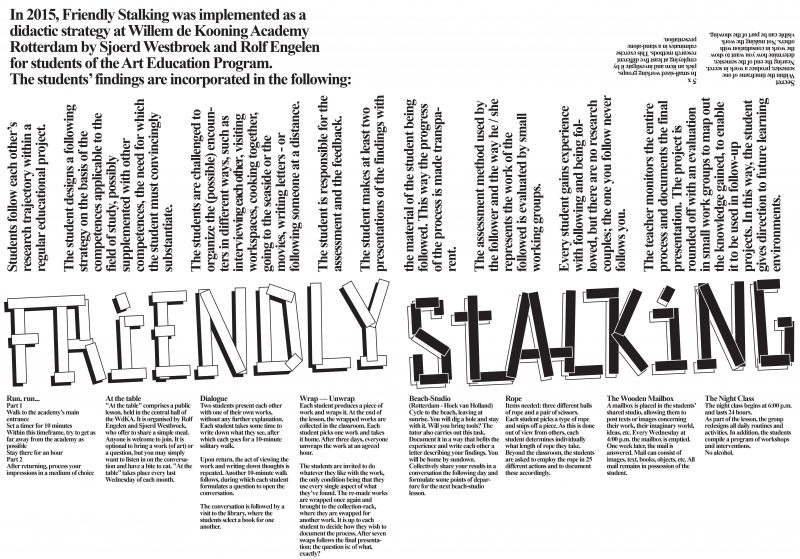
In the case of RASL, Friendly Stalking was proposed as a way of strengthening relationships between the participating institutions: Codarts, Erasmus University Rotterdam and Willem de Kooning Academy. Starting from the belief that the collaboration would benefit from an in-depth understanding of the practice of a colleague from the partner institution, each member of a volunteering group of tutors, researchers and administrators committed to following a person from one of the other institutions. As a pilot project, the idea of Friendly Stalking was introduced to members of staff, but it can easily be adjusted to work for Double Degree students as well. An outline of a Friendly Stalking trajectory, as developed at the Willem de Kooning Academy, is offered below.
To “friendly stalk” someone means to follow him or her, but what this involves is up to the follower to decide. Although the aim is to strengthen the design of a learning environment for a group of practitioners, there is no fixed format in terms of the outcome of an individual trajectory. The act of following is not reciprocal: person A follows person B, B follows C, etc. How each trajectory materializes is up to the participants. Friendly Stalking encourages embracing the partial nature of knowledge and acknowledges the importance of informal spaces within institutional environments to facilitate encounters with new perspectives. This is emphatically not meant as a privatisation or individualisation of either education or knowledge but as a starting point to examine how one can reformulate one's own position vis-à-vis the position of the other. The aim of Friendly Stalking is to temporarily free oneself from disciplinary constraints, as defined by institutional contexts, and to recognize the generosity of the other in allowing to be observed.
A DIY Friendly Stalking Toolkit